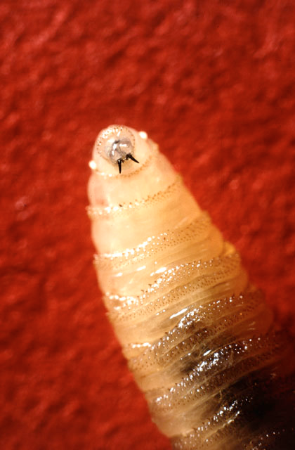
Source: TAMU AgriLife Extension
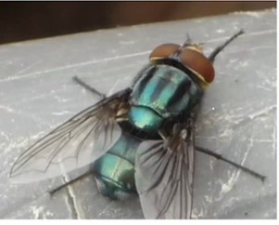
Photographer: John Kucharski Source: USDA Agricultural Research Service
ADULTS: Adult New World screwworms (NWS), Cochliomyia hominivorax, are metallic blue blow flies with three distinct stripes that run down the top (thorax) of the fly just behind the head with large orange eyes. Once the flies die, they instantly start losing their blue and greenish coloration. Confirmation of the fly identity can be determined only by a trained individual. Adult flies of interest can be photographed and emailed to the Texas A&M AgriLife Extension Service at screwworm@ag.tamu.edu.
LARVAE: The distinctive odor of screwworm feeding on live flesh is often a first sign of detection. The larval stage is responsible for causing significant injury and economic loss, as they inhabit the wounds of living animals and cause extensive tissue damage. Mature larvae can reach 17 mm in length (2/3 of an inch) and have spines that protrude from the body and wrap around in a spiral giving them the name screwworm. Official identification of larvae is based largely on the presence or absence of dual internal breathing tubes.
The NWS inflicts economic losses and serious animal health challenges by infesting wounds and causing rapidly expanding tissue damage. The newly hatched larvae burrow into live tissue, feed aggressively and cause a condition known as myiasis. Livestock that have myiasis are immediately at risk of significant health issues and can die within a week or two of contracting the condition if not treated promptly. Geographic spread of NWS is mostly due to infected animals being transported by humans and less due to adult fly’s ability to fly long distances.
The female NWS fly lays eggs in and around open wounds or sores within mucous membranes of warm-blooded animals. Thousands of eggs can be laid by several females and once NWS become established on an animal, the larvae will remain on that same animal (will not be transferred to other livestock) and will finish their feeding period in 5 to 7 days before dropping to the ground to pupate and complete the life cycle. In warm (80+ᴼF daytime highs) and tropical conditions the full C. hominivorax life cycle may be complete in 2–3 weeks.
The pest was eradicated in the U.S. in the 1960s. Since then, it occasionally reemerges and has resurfaced in Central America and Mexico. They are controlled only through the release of sterile males, known as the sterile insect technique (SIT). This approach, along with regular active surveillance and livestock inspections, has proven highly successful.
UPDATE: June 3, 2026—The U.S. Department of Agriculture’s (USDA) Animal and Plant Health Inspection Service (APHIS) confirmed the detection of a New World screwworm (NWS) in a bovine in Zavala County, Texas.
Native Origin: Caribbean to South America
Habitat: Historically, screwworms have been especially lethal to newborn livestock, with wet navels being especially attractive egg-laying sites for NWS flies. For operations that birth in pastures, the timing of breeding and birthing may need to be adjusted to cooler times. Important to this effort is having defined birthing and breeding seasons, as opposed to leaving sires with females year-round. Producers, wildlife managers, and landowners should be alert for possible signs associated with potential infestation including:
U.S. Present: Increasing detections of this fly north of its containment barrier, the Darian Gap in Panama, were noted in 2023. The re-emergence of NWS in Costa Rica, Nicaragua, Honduras, and Guatemala beginning in mid 2023 and early 2024, and expansion into Mexico (2024) has increased NWS surveillance in the Rio Grande Valley and other crop-producing areas along the southern Texas border.
UPDATE: June 3, 2026—The U.S. Department of Agriculture’s (USDA) Animal and Plant Health Inspection Service (APHIS) confirmed the detection of a New World screwworm (NWS) in a bovine in Zavala County, Texas.
USDA and Texas officials are taking immediate action to contain and eradicate NWS from the United States, following the strategies and actions outlined in the NWS Response Playbook. This includes:
This fly resembles the secondary screwworm, Cochliomyia macellaria, which is also a metallic blue blow fly with three distinct stripes, but the stripes all begin at the same point behind the head. Also, te secondary screwworm does not harm living animals because it will only deposit eggs on carcasses.
Stay informed at https://screwwormtx.org/ - because proactive, management-focused strategies based on seasonal timing, geographic awareness and frequent herd and flock surveillance are critical for preventing NWS infestations. Please follow these steps if you suspect NWS.
Early detection and reporting is critical. Report all suspected and confirmed cases of NWS immediately. From 8:00 AM - 5:00 PM, contact a local Texas Animal Health Commission region office.
While some management practices can be confined to seasons with lower fly activity, it is not realistic that every operation can immediately reschedule management during these times. The important message is that if flies are active and livestock have wounds of any size, diligence in monitoring for NWS and utilizing best management practices to promote healing are critical. You can also reach out to the Texas A&M Veterinary Medical Diagnostic Laboratory for services in your area
CHEMICAL: Typical insecticide suppression of the New World screwworm is less effective than with other insect pests due to its wide host range and occurrence on wildlife.
Bermúdez, S. E., Espinosa, J. D., Cielo, A. B., Clavel, F., Subía, J., Barrios, S., & Medianero, E. (2007). Incidence of myiasis in Panama during the eradication of Cochliomyia hominivorax (Coquerel 1858, Diptera: Calliphoridae)(2002-2005). Memórias do Instituto Oswaldo Cruz, 102, 675-679.
Dyck, V. A., Reyes Flores, J., Vreysen, M. J. B., Regidor Fernández, E. E., Teruya, T., Barnes, B., ... & Loosjes, M. (2005). Management of area-wide integrated pest management programmes that integrate the sterile insect technique. In Sterile insect technique: principles and practice in area-wide integrated pest management (pp. 525-545). Dordrecht: Springer Netherlands.
Krafsur, E.S., Luis Garcia, L., Responses of the Screwworm, Cochliomyia Hominivorax, to Two Sterile Male Release Methods in South Texas, 1975–1976, Journal of Medical Entomology, Volume 14, Issue 6, 7 June 1978, Pages 687–697, https://doi.org/10.1093/jmedent/14.6.687
Oliveira, P. C., Moraes, P. A., Scott, F. B., Verocai, G. G., Correia, T. R., & Fernandes, J. I. (2018). Efficacy of spinosad on the treatment of myiasis caused by Cochliomyia hominivorax (Diptera: Calliphoridae) in dogs. Veterinary Parasitology, 258, 53-56.
Skoda, S. R., Phillips, P. L., & Welch, J. B. (2018). Screwworm (Diptera: Calliphoridae) in the United States: response to and elimination of the 2016–2017 outbreak in Florida. Journal of Medical Entomology, 55(4), 777-786.
Valdez-Espinoza, U. M., Fadda, L. A., Marques, R., Osorio-Olvera, L., Jiménez-García, D., & Lira-Noriega, A. (2025). The reemergence of the New World screwworm and its potential distribution in North America. Scientific Reports, 15(1), 23819.
Internet Sources:
https://agrilifeextension.tamu.edu/new-world-screwworm-fact-sheet/
https://agrilifeextension.tamu.edu/rethinking-livestock-management-to-consider-screwworm/







© 2014 Texas Invasive Species Institute. All Rights Reserved
Lamar University | Sul Ross State University | Texas State University, San Marcos