

Pest and Diseases Image Library (PaDIL) , Bugwood.org.jpg
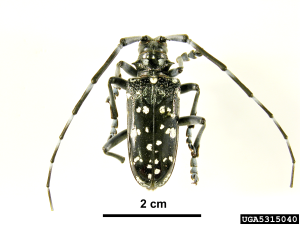
ADULTS: The citrus longhorned beetle is a large, wood-boring beetle native to Asia. Adults are typically 1–1.5 inches (21–37 mm) long, with a shiny black body marked by distinct round white spots. Their long, banded antennae can be longer than their body, especially in males.
LARVAE: Are cream-colored, legless grubs that live inside trees, where they are rarely seen. Because most of the damage occurs inside the tree, infestations often go unnoticed until symptoms become severe.
Citrus longhorned beetles pose a significant threat because they attack healthy, living trees, unlike many native wood-boring insects that primarily target stressed or dead wood. This ability increases its potential to impact both natural forests and managed landscapes. Larval feeding tunnels deep into the trunk and root collar, disrupting the flow of water and nutrients. Over time, this leads to canopy thinning, branch dieback, structural weakening, and eventual tree death. Exit holes created by emerging adults can also allow fungi and pathogens to enter, accelerating decline.
Although this species is not currently established in Texas or the United States, its repeated introductions through global trade pathways highlight the ongoing risk. Early detection is critical to prevent establishment and widespread impact.
Citrus longhorned beetle undergoes complete metamorphosis with four life stages: egg, larva, pupa, and adult. The life cycle typically takes one to two years, depending on environmental conditions. Females lay eggs individually in small cuts they create in the bark, usually near the base of the trunk or exposed roots. A single female can lay up to 200 eggs over her lifetime. Eggs hatch within one to three weeks.
After hatching, larvae tunnel deep into the wood, feeding on internal tissues that transport water and nutrients. This stage causes the most damage and can last one to several years. Because larvae are hidden inside the tree, infestations are difficult to detect early. Pupation occurs within the tree, and adults emerge between spring and late summer (April–August). After emerging, adults feed, mate, and begin the cycle again.
Not established in the United States. Detections of CLB occurred through the movement of infested wood packaging materials and live plants, such as bonsai and nursery stock, but have been successfully eradicated. A notable case in Tukwila, Washington (2001) required removal of infested and nearby trees, chemical treatments, and multi-year monitoring before eradication was confirmed.
Native Origin: Eastern Asia (China, Japan, Korea, and surrounding regions)
U.S. Habitat: The beetle has a very broad host range, including many tree species common in Texas such as maple (Acer), elm (Ulmus), willow (Salix), fruit trees, and ornamental species. If established, it would impact urban forests, nursery industries, and natural ecosystems across the state.
U.S. Present: Not established. Past detections (e.g., Washington State) have been successfully eradicated. Continued interceptions at ports of entry indicate ongoing risk
RESEMBLES: Citrus longhorned beetle closely resembles the Asian longhorned beetle (Anoplophora glabripennis), another invasive species. It may also be confused with native longhorned beetles such as Monochamus species (pine sawyers).
Key differences include:
Accurate identification is critical, and suspected specimens should be reported.
Early detection and rapid response are essential for preventing establishment. Public awareness and reporting play a critical role in early detection and successful eradication efforts.
Prevention:
Detection:
Control:
Text References
Ackerman, J.D., & González-Orellana, N. 2021. Explosive range expansion of Eulophia graminea (Orchidaceae) in Puerto Rico and the West Indies. Lankesteriana 21(3):307–312.
Kolanowska, M. 2024. Climate change will likely facilitate invasion of Asian orchid Eulophia graminea. Biological Invasions.
Pemberton, R.W., Collins, T.M., & Koptur, S. 2008. An Asian orchid, Eulophia graminea (Orchidaceae), naturalizes in Florida. Lankesteriana 8(1):5–14.
Singhurst, J.R., Mink, J.N., & Holmes, W.C. 2020. Eulophia graminea (Orchidaceae) naturalized in Texas. Phytoneuron 2020-22:1–5.
Internet Sources
USDA APHIS
EDDMapS
Bugwood
UF IFAS
iNaturalist







© 2014 Texas Invasive Species Institute. All Rights Reserved
Lamar University | Sul Ross State University | Texas State University, San Marcos
