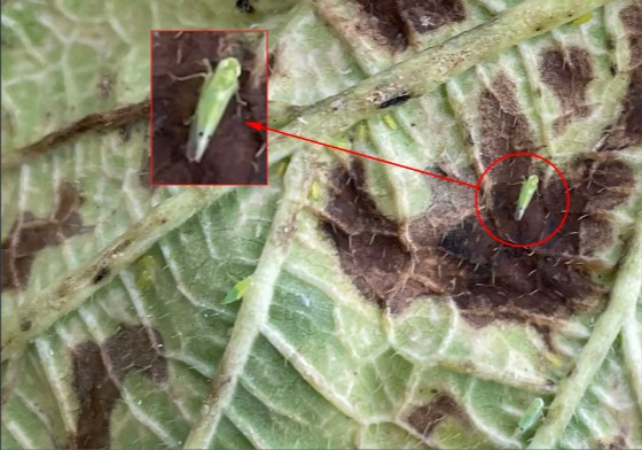
Photographer: Isaac Esquivel Source: University of Georgia Extension
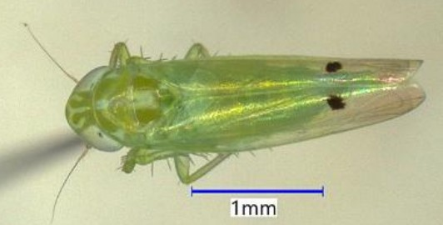
Photographer: Shirley Cruz Source: USDA
Adults of the Cotton Jassid are tiny (2-3mm) and pale green with yellowish-green wings, with a single dark spot on each wing, with some having two spots on their head. The pair of black spots is how to identify from native leafhopprs. Both nymphs and adults are found on the underside of the leaf, and plant damage is likely to be noticed in areas with heavy leafhopper infestation.
Populations and symptoms usually begin on field edges before moving into the field. The Cotton jassid is a sap-sucking insect that injects its saliva into the plants to drain the phloem. At later stages, reddening/bronzing of entire leaves can be seen with leaves falling off and severely affected plants showing stunted growth. Their feeding causes leaves to curl, yellow and increase crop yield loss up to 50% in severe cases.
Like other leafhoppers in the subfamily Typhlocybinae, two-spot cotton leafhoppers feed on the lower surface of leaves, extracting the contents of the cells. The leafhoppers themselves are tiny, so it is likely the plant damage will be observed before the insects themselves. Eggs are inserted in slits in the leaf veins. The nymphal period lasts between 5–16 days. Males lived 15–34 days and females lived 17–37 days.
It was found in Puerto Rico in 2023, followed by other Caribbean Islands and Florida in 2024. When the pest first invaded Florida, it was detected in high numbers in okra. By 2025, infestations had been reported in multiple counties in Georgia, Alabama, South Carolina, North Carolina, Mississippi, Louisiana, and Texas. Cotton Jassid was first identified in Texas on hibiscus plants in big box store nurseries, plants shipped from nurseries outside the state, and has since been found in cotton fields, including in Fort Bend County south of Houston.
Current Quarantined Texas Counties: Bexar, Brazoria, Brazos, Cameron, Dallas, El Paso, Fort Bend, Galveston, McLennan, Nueces, Victoria
If you suspect a cotton jassid infestation in your field or on nursery stock, contact TDA at PlantQuality@TexasAgriculture.gov, call (512) 463-7660, or contact your nearest TDA Regional Office.
Native Origin: Iran to Japan and Indonesia
Habitat: Cotton jassid has a broad host range mainly within the families Malvaceae, Fabaceae, Asteraceae, and Solanaceae. This includes cotton, okra, peanuts, soybeans, sunflowers, eggplant, potato, and many ornamental plants. To this point, observations have been that corn, soybeans, and peanuts are more likely to be incidental hosts. No reproduction or injury has been documented in these crops in the US.
U.S. Present: AL, FL, GA, LA, MS, NC, TN, TX and SC.
If you suspect a cotton jassid infestation in your field or on nursery stock, contact TDA at PlantQuality@TexasAgriculture.gov, call (512) 463-7660, or contact your nearest TDA Regional Office.
Texas: Current Quarantined Counties - Bexar, Brazoria, Brazos, Cameron, Dallas, El Paso, Fort Bend, Galveston, McLennan, Nueces, Victoria
Early reporting is crucial for effective management and containment of this invasive pest. If you suspect a cotton jassid infestation in your field or on nursery stock, contact PlantQuality@TexasAgriculture.gov, call (512) 463-7660, or contact your nearest TDA Regional Office.
Gulf Coast Regional Office, Houston
North Texas Regional Office, Dallas
South Central Regional Office, San Antonio
West Texas Regional Office, Lubbock
Valley Regional Office, San Juan
The Texas Department of Agriculture has enacted an emergency quarantine to stop the spread of the invasive two-spotted cotton leafhopper. The quarantine applies to shipments from Alabama, Florida, Georgia, Louisiana, Mississippi, Tennessee, South Carolina, and North Carolina, where the pest has been detected. The quarantine also includes all counties within Texas where the jassid has been reported, halting movement of hostable living plants without phytosanitary documentation.
CHEMICAL: Because there are several leafhopper species found in cotton, it is important to confirm adults in the field or to see symptoms somewhere in the field before making an application. The Texas Department of Agriculture suggests generic treatment for leafhoppers to facilitate plant shipments.
Cabrera-Asencio, I., Dietrich, C.H. and Zahniser, J.N. (2023). A new invasive pest in the Western Hemisphere: Amrasca biguttula (Hemiptera: Cicadellidae). Florida Entomologist 106: 263–266.
Ghosh, S.K. and Karmakar, R., 2021. Sustainable control of leaf hopper (Amrasca biguttula biguttula Ishida) on grape vine (Vitis vinifera L.). Journal of Zoology, 42(21): 83-99.
Nagrare, V.S., Bisane, K.E., Deshmukh, A.J. and Kranthi, S. (2012). Studies on life cycle parameters of cotton leafhopper, Amrasca biguttula biguttula (Ishida). Entomon 37: 93–99.
PPQ. 2025. Cooperative Agricultural Pest Survey (CAPS) Pest Datasheet for Amrasca biguttula (Cicadellidae): Cotton jassid. United States Department of Agriculture, Animal and Plant Health Inspection Service, Plant Protection and Quarantine (PPQ), Raleigh, NC.
Thapa, R., Bista, K., Bhatta, M., Bhandari, S., Acharya, S.R. and Sapkota, B., 2019.Comparative performance and economic efficiency of different pesticides against okra jassids (Amrasca biguttula biguttula): Their impact on okra yield and growth attributes. Journal of Entomology and Zoology Studies, 7(5): 525-531.
Wagen, T.A., Jessar, M.A., Abbasi, N.H., Khuhro, S., Abro, M.A., Bughio, A.N., Junejo, A.S. and Pathan, G.M., 2019. Evaluation of colored sticky traps for monitoring and managing the jassid population in okra. Journal of Biology, Agriculture and Healthcare, 9(11): 35-38.
Internet Sources:
https://www.cotton.org/tech/pest/upload/Cotton-Jassid-alert-flyer.pdf







© 2014 Texas Invasive Species Institute. All Rights Reserved
Lamar University | Sul Ross State University | Texas State University, San Marcos